Where the Mecha Comet fits into my self-hosting setup
How a small Linux handheld device may integrate into my Tailnet and self hosting, possibly allowing me to replace my daily smartphone
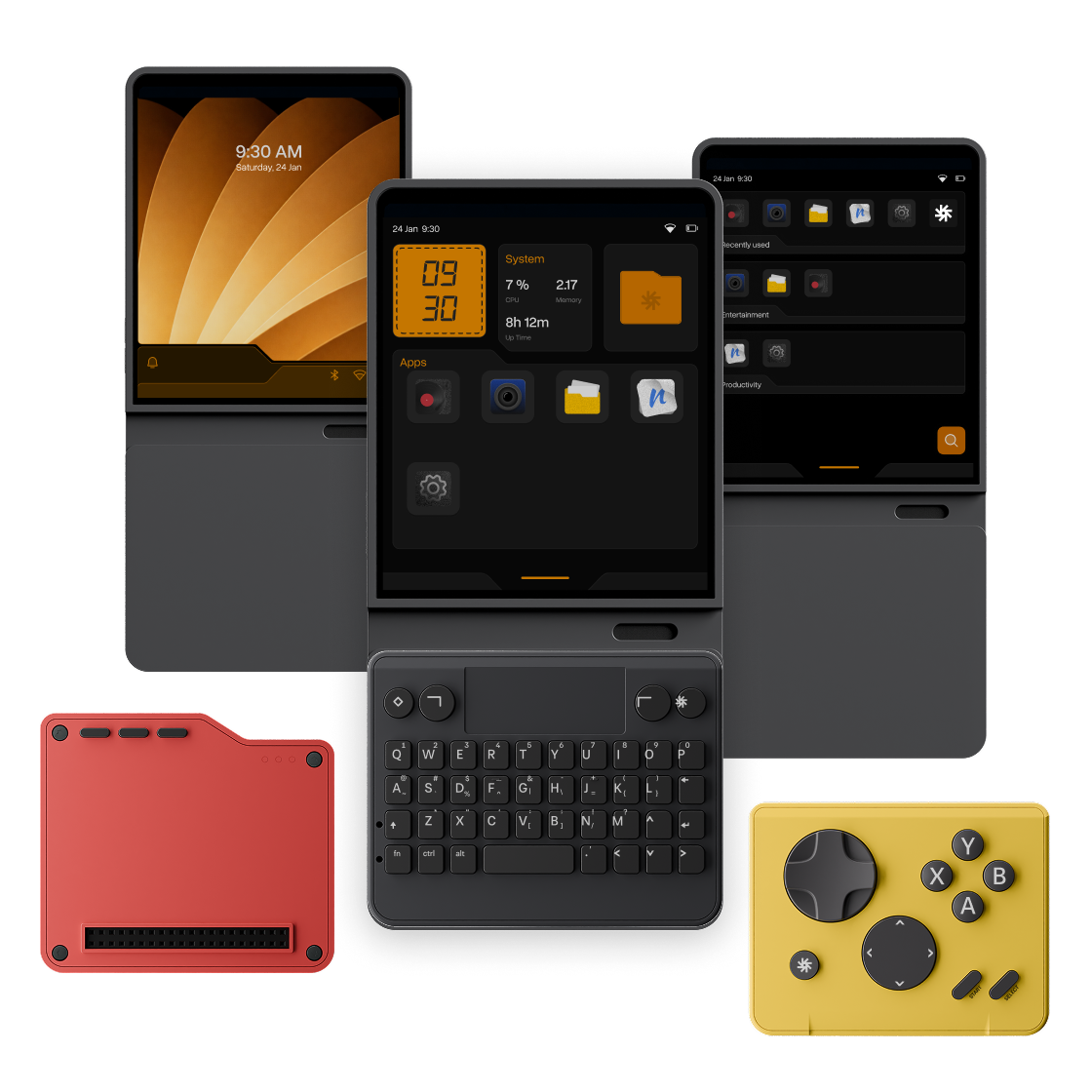
I'm sure that the holy grail of a fully working Linux Phone will appear at some point in the future. Until then I am having to tweak de-Googled Android or PostmarketOS (Linux). The de-Googled Android works well as a daily driver. But ... it's still Android and who knows how much further down the closed source rabbit hole Google are going to take this? NuraOS, formerly, PostmarketOS, on my OnePlus 6 is not good enough yet for daily driving. I have pinned some hopes on the forthcoming Mecha Comet, which I helped back the development of, in May 2026. This interesting project is a proper linux handheld which hopefully will be released in January 2027.
This video from lead Mecha developer, Shoaib, explains the Comet device. Potential is enormous!
Specs and software stack. Mecha Comet Website ... the Comet is an open modular Linux handheld; I've ordered a 6-core ARM processor, 8GB RAM and 128GB storage. NVMe and SD expansion, and M.2 LTE support — with the LTE, VoLTE add-on listed as shipping January 2027. Their software side includes the Mechanix GUI shell, a Flutter-based toolkit, and Mecha Make image builds.
As a short aside, I also have a Unihertz Jellystar which I use as my "Slop Phone". This is standard Android and has any Government or banking apps that wont run elsewhere. I also use it as a hotspot for other phones when away from my home network.
So how can the Mecha Comet integrate into my digital life? I have this vision of a perfect system where all the Apps I require on the device are created by me. There are no Apps from third parties, apart from the few standard apps delivered with the device by Mecha (Files, Camera, System, Music, Notes). There will be little direct integration with outside cloud companies, only if necessary. A secure Web browser does most of the additional work.
The integration of Tailscale into my home network has made things much easier for me. We share a friend's internet. He has fibre optic and uses point-to-point wireless dish to send the signal to my house. It's free, which is nice, but getting reverse proxies sorted is a nightmare. That is where Tailscale comes in. Any device on my Tailnet can talk to each other either, from within my home network or remotely. Works really well and saves my reverse proxy headaches and associated privacy implications. I use Tailscale as it makes it more convenient and easier to use WireGuard to secure network connections.
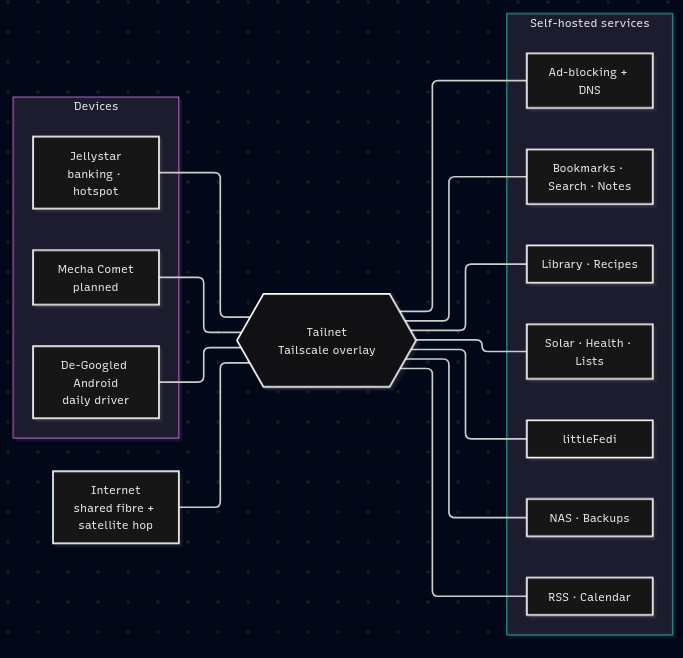
Hosted at home on a Raspberry pi 5 (2gb RAM) are:
- Network-level advertisement and Internet tracker blocking (Pihole)
- Bookmarking (Linkding)
- Search (SearXNG)
- Notetaking (Memos)
- Health Metrics (hand built)
- Solar Assistant
- Book Library - (Calibre-Web)
- Shopping List (hand built)
- Recipe Cards (Almanac)
- Cooking Recipes (Cooklang)
All of these work really well on a mobile platform and I have no reason to believe that the Mecha Comet will not display them correctly. This remains to be tested though and a suspect a few tweaks will be required to the software/media screens.
Our whole Social Network life is now based on LittleFedi and runs on an OrangePi 4 Pro (4gb RAM) in the bedroom. It serves an internet domain using a Cloudflare tunnel.
LittleFedi is a small ActivityPub server written in Go. It ships as a single static executable with a server-rendered web interface, a Mastodon-compatible client API, a durable federation queue, moderation tools, and optional PostgreSQL and S3 support. No runtime to install, no services to wire together.
I have a Synology NAS which we use for file sharing and network backups. This is also on our Tailnet.
Apps hosted online on my website (via Hostinger) are:
- RSS Reader (FreshRSS)
- Calendar (hand built)
Chat - I guess Signal, my preferred chat app, won't view correctly on the Comet. I suspect DeltaChat will though, as this works fine on the Nura (PostmarketOS) Oneplus 6, which is based on Alpine Linux.
Will it work as a mobile phone? LTE/GNSS Upgrade Kit (with modem) - The Quectel EM060K-GL modem will enable Data, Voice (+VoLTE), SMS and GNSS related features. Without Google's push infrastructure though, nothing wakes the device. A self-hosted ntfy instance on a Pi, feeding both the Comet and my Android devices, is possibly the answer. I will install and try as this could make the difference between a pocket computer and a phone.
I await January 2027 with much anticipation. In the meantime I will continue building.