Posted on:
I’ve spent five weeks recently in Patagonia, a place that embodies the very idea of pristine wilderness. But on recent visits, something has shifted, something that makes me uncomfortable. A new kind of landscape is emerging, not carved by glaciers but by capital. It’s dressed in the language of sustainability but built on the logic of exclusivity.
They call it "Eco" tourism. But what does that word mean?
True ecotourism promises responsible travel that conserves the environment, sustains local people and educates visitors. What I see, however, is different. I see "Eco" as a marketing tool, a stylish camouflage for a rich consortium to buy up prime wilderness, cut roads through it, and build luxurious, low-profile lodges nestled in the trees. The price tags are not for recovering costs, they are for purchasing exclusivity.
Call me cynical, but I don't believe these consortiums have the environment at heart when they plough millions into a project. They see a return on investment. Expansion? It’s just good business. Build another hotel, another pod, another exclusive trail.
I’ve seen it with my own eyes near El Chalten in November!
Take the "Reserva Privada los Huemules". The name suggests a protected haven. Yet, their current development includes 92 residential lots and a hotel. This isn’t conservation; it’s real estate. In December 2024, they charged ARS 36,000 per day simply to enter and walk their trails. Los Huemules Private Park
Nearby, the Explora Lodge offers a 3-night stay for two in December 2025 for a cool USD $9,120. For the price of a used car, you can experience what was once natural forest. Explora - El Chalten Lodge
 The roof of the black Explora hotel peeping out over the forest
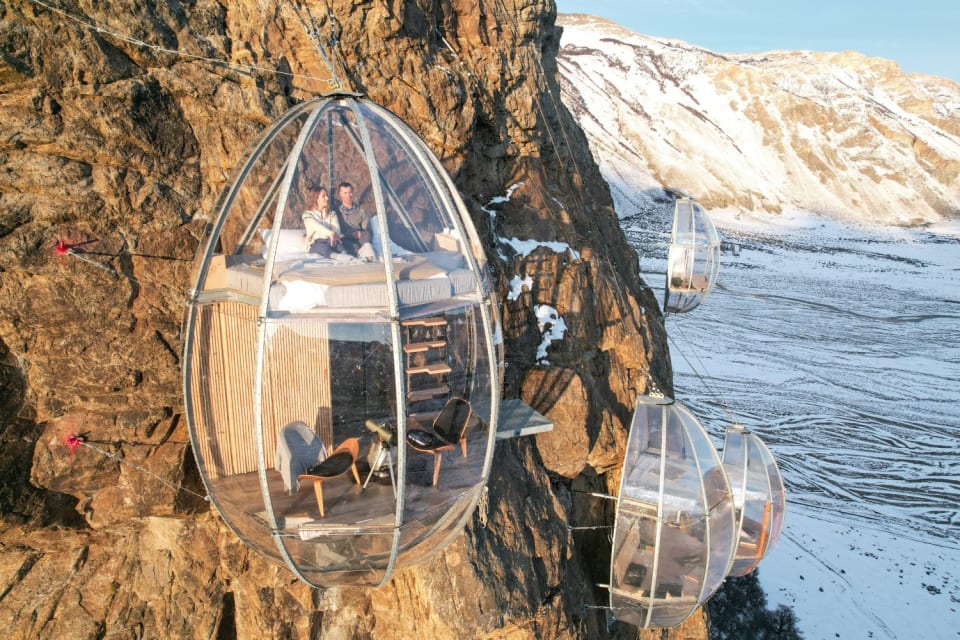
Most surreal of all are the transparent capsules clinging to a cliff side, visible from the main road. A via ferrata leads you to your pod for the night. The cost to commune with nature in this engineered solitude? USD $2,200 per night. Ovo Patgonia
 The pods/capsules attached to a cliff
All their websites speak eloquently about "conservation," "preservation," and "connection." This begs the uncomfortable question: Why should they be chosen as the conservationists?
A national park’s mandate is preservation for all generations. A private consortium’s mandate is profit for its shareholders. This is an irreconcilable conflict of interest. Conservation becomes conditional, protected only as long as it is profitable. Access becomes a premium product.
Is this what "Eco" tourism is all about? Is this the future, placing pristine wilderness into the hands of private billionaires to be curated. modified and sold back to us as a luxury experience?
When does a conservation area become a conservation business?
Patagonia stands at a crossroads. One path leads to a future where wilderness is a gated asset, a serene backdrop for the ultra-wealthy. The other leads back to the core principles of true ecotourism and public protection, where conservation benefits ecosystems and local communities, and awe-inspiring places remain for all.
The question we must answer is no longer just about saving Patagonia. It’s about deciding for whom we are saving it.
Tagged with:
More posts: